

AI, education and the future of work
22 April 2026
/17x0:1756x1182/prod01/channel_3/media/intranet/communications/DHP_2024_04_10_91资源全集_VC_Shan_Wareing_002_LR.jpg)
Article Written By
Professor Shân Wareing, 91资源全集 University Vice-ChancellorOn her second anniversary at 91资源全集, Vice-Chancellor Professor Shân Wareing reflects on what artificial intelligence means for education, graduate employability, and the University's next two years
It’s been a privilege to serve as Vice-Chancellor at 91资源全集 University (and CEO of 91资源全集 University Higher Education Corporation, to give us our full legal name). Two years in, and I’m thinking about what needs to shape our next two years.
A changing world
Every now and then the world adjusts in response to a seismic event - war, or technological developments, for example. It looks like we’re in one of those moments now, as the impact of generative AI on graduate jobs, our educational offer and operational functions starts to make itself felt. And what it means to deliver our mission in the context of AI is going to mean we need to review how we do things. One of the questions for education and preparation for employment will be, what do humans do that is distinct from what Generative AI can do?
AI can handle huge data sets; synthesising information at scale and pace, it can help us understand and tackle wicked problems. It can look at (or borrow from or plagiarise from, depending on your perspective) what’s been done before and recreate it, at high speed. It will relieve humans of certain kinds of tasks, and complete them more quickly, at least as accurately, and possibly better, than humans reliably can. But many things humans do, AI is not able to do, and despite the rhetoric around Artificial General and Agentic Intelligence, shows no sign of being able to do. And if you asked me for examples, I’d direct you to the list of 91资源全集 University Graduate Competencies.
Graduate competencies
This set of competencies, developed with input from employers, graduates and students at our three global campuses is a great antidote to concerns about graduate unemployment or the point of a university education.
There are qualities organisations need that AI cannot offer, like leadership. There are qualities organisations need that AI can mimic but does not actually offer, like empathy. Using our graduate competencies as a refence point will help us engage productively with AI, and support our graduates to use AI without seeing it as a rival for what is uniquely human. This is also incredibly fertile territory for research and knowledge exchange.
When we focus on developing and assessing these competencies - which in Bloom’s taxonomy of learning goals, would appear in the affective domain and in the higher tiers of learning goals in the cognitive domain - we simultaneously contribute to protecting our academic standards from compromise, our students from irrelevance, and our graduates from underemployment. When we offer expertise in these areas, we can support our partners in navigating a landscape which is challenging and evolving at pace for them too.
Universities should lead the way
Who leads and creates stability in times of change and disruption? I think we do – universities - who research society’s pressing uncertainties and problems to provide frameworks and answers, who prepare students for careers and professions, who support partners and businesses with knowledge exchange and continuing professional development, who are networked nationally and globally. If we wait for the go ahead from government, or quangos, or for commercial organisations to set the agenda, the future will be shaped without us, and not only will it probably not be what we’d chose, we’ve also undercut our own role and reason for being. So change needs to be something we embrace and absorb.
Our challenge is to ensure our focus in learning, teaching, assessment and the wider student experience is clearly and unambiguously on our graduate competencies while at the same time we develop our own and our students’ understanding of, and skills in AI, for use in our work and other aspects of our lives. It is to focus our research activity on issues that are important and urgent for our stakeholders and partners, such as how they adapt to the opportunities, threats and risks of AI. This includes the employers and sectors our graduates will work in. We can help them to design the workforce of their futures, shaping roles and scoping the skills, and behaviours needed.
What 91资源全集 University is doing
Colleagues across the University are already working together to capture ideas and work in partnership with our students to develop AI resources and case studies. These will be made available so that we can learn from each other’s expertise and innovations, supporting our students to be confident and to stand out from their peers in this area. At 91资源全集, we're actively developing how we recognise and share our AI work - across teaching, research and wider activities of the University. I'll share more on that soon here on 91资源全集 Voices and on my LinkedIn.
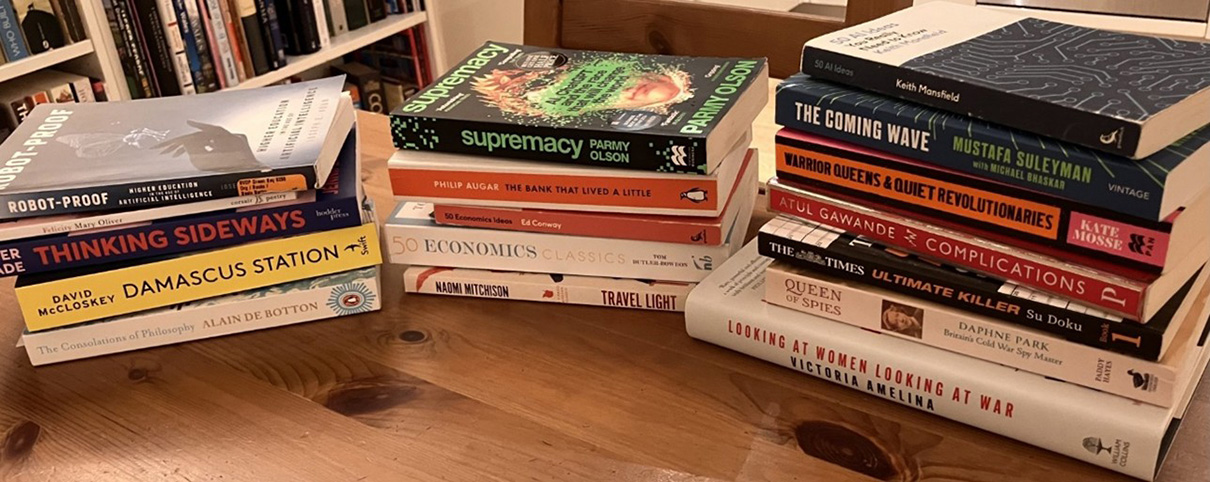
I will celebrate my two year anniversary by continuing to study, and completing , alongside my recent, current and planned AI reading (a few non AI books sneaked in too).
Find out about undergraduate and postgraduate courses in AI: